
Wondering where your weight stands? This free BMI calculator gives you an instant reading based on your height and weight with a clear breakdown of what your number means. No sign-up required.
BMI Calculator
Check your Body Mass Index in seconds
| Category | BMI Range |
|---|---|
| Underweight | < 18.5 |
| Normal weight | 18.5 – 24.9 |
| Overweight | 25.0 – 29.9 |
| Obese | ≥ 30.0 |
Disclaimer: BMI is a general screening tool and does not account for muscle mass, bone density, age, or ethnicity. It should not be used as a medical diagnosis. Please consult a healthcare professional for personalized advice.
How to use this BMI Calculator
Using this calculator takes less than 30 seconds. Start by selecting your preferred unit system, Metric (kg/cm) or Imperial (lb/ft). Enter your height and weight in the input fields, then hit “Calculate BMI.” Your result will appear instantly below, along with a color-coded gauge showing exactly where your BMI falls on the scale.
The calculator supports both measurement systems, so whether you’re used to kilograms and centimeters or pounds and feet, you’re covered. You can switch between the two at any time without losing your inputs.
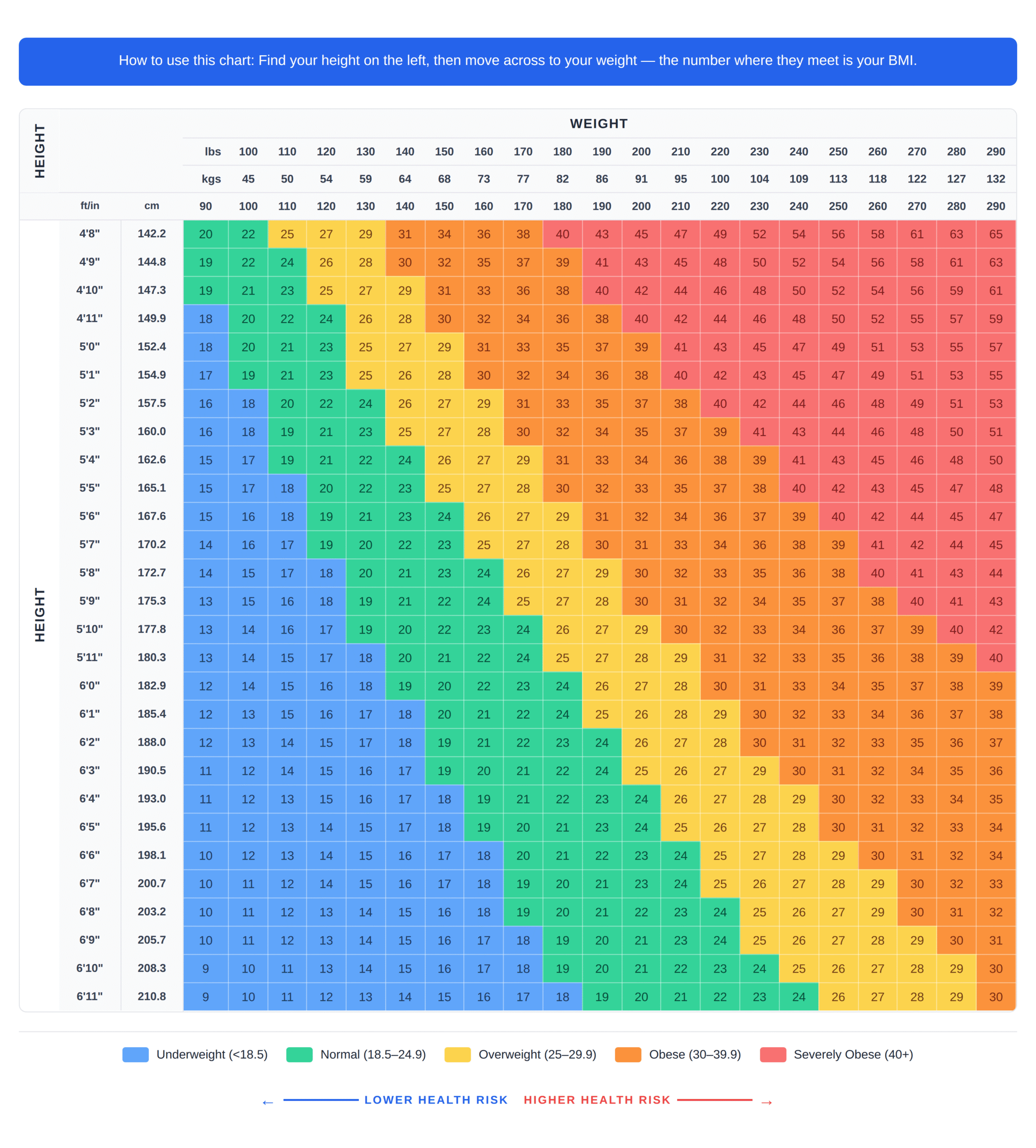
Understanding your BMI Results
Once you calculate your BMI, your result will fall into one of four standard categories recognized by the World Health Organization (WHO):
Underweight (Below 18.5): A BMI under 18.5 may indicate that your body weight is lower than what’s generally considered healthy for your height. This can sometimes be linked to nutritional deficiencies, weakened immunity, or other underlying conditions. It’s worth discussing with a healthcare provider if your BMI consistently falls in this range.
Normal Weight (18.5 – 24.9): A BMI in this range suggests that your weight is within a healthy proportion relative to your height. This range is generally associated with a lower risk of weight-related health problems. That said, BMI alone doesn’t tell the full story — factors like muscle mass, diet quality, and activity level all matter.
Overweight (25.0 – 29.9): A BMI between 25 and 29.9 indicates that body weight is higher than what’s typically recommended for your height. This range is associated with an increased risk of conditions like type 2 diabetes, high blood pressure, and cardiovascular issues. Small lifestyle adjustments — such as regular walking and improved nutrition — can make a meaningful difference.
Obese (30.0 and above): A BMI of 30 or higher falls into the obese category, which carries a significantly elevated risk of serious health conditions including heart disease, stroke, certain cancers, and metabolic disorders. If your BMI is in this range, consulting a doctor for a comprehensive health assessment is strongly recommended.
What BMI can't tell you
While BMI is a useful screening tool, it has important limitations that are worth understanding:
It doesn’t measure body fat directly. BMI is based purely on height and weight. It can’t distinguish between muscle, fat, bone, and water. This means a muscular athlete could have a “high” BMI while actually being in excellent health.
It doesn’t account for fat distribution. Where you carry fat matters. Visceral fat (around the organs) poses greater health risks than subcutaneous fat (under the skin). Two people with the same BMI can have very different health profiles depending on their fat distribution.
It varies by age, sex, and ethnicity. Older adults tend to have more body fat than younger adults at the same BMI. Women generally carry more body fat than men at equivalent BMI levels. And BMI thresholds may not apply equally across all ethnic groups — some populations face elevated health risks at lower BMI values.
It’s not designed for everyone. BMI is not appropriate for children (who have separate growth-based charts), pregnant women, or individuals with certain medical conditions. It should always be used alongside other assessments, not as a standalone diagnosis.
For a more complete picture, consider pairing your BMI result with a body fat percentage measurement, waist-to-hip ratio, or a consultation with your healthcare provider.
Frequently Asked Questions
What is BMI?
BMI stands for Body Mass Index. It’s a numerical value calculated from your height and weight that provides a general indication of whether your body weight falls within a healthy range. The formula divides your weight in kilograms by the square of your height in meters (kg/m²).
What is a healthy BMI for adults?
A BMI between 18.5 and 24.9 is generally considered healthy for most adults. However, “healthy” varies from person to person depending on factors like age, muscle mass, and overall fitness level. Your BMI should be interpreted alongside other health indicators.
How accurate is a BMI calculator?
BMI calculators are mathematically accurate, they correctly apply the standard formula. However, BMI as a metric has limitations. It doesn’t account for muscle mass, bone density, or fat distribution. It’s best used as a screening tool rather than a definitive health diagnosis.
Is BMI the same for men and women?
The formula is identical for both men and women. However, interpretation can differ slightly because women naturally carry a higher percentage of body fat than men at the same BMI. Some healthcare providers use additional measurements alongside BMI for a more complete assessment.
How often should I check my BMI?
For most adults, checking BMI once every few months is sufficient unless you’re actively working on weight management goals, in which case monthly tracking can help you monitor progress. Avoid checking too frequently, as daily weight fluctuations are normal and not meaningful.
Can BMI be too low?
Yes. A BMI below 18.5 is classified as underweight and can be associated with health risks including weakened immunity, nutrient deficiencies, bone loss, and fertility issues. If your BMI is consistently below 18.5, it’s worth speaking with a healthcare provider.